
Why We Knock on Doors Before Entering
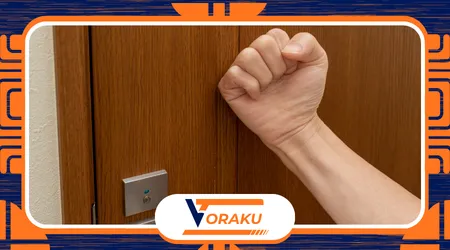
We Knock on Doors Before Entering because the history of architecture is, in essence, the history of human withdrawal. Imagine a rain-slicked street in Victorian London, 1870.
A visitor approaches a heavy mahogany door, not with a shout or a brazen push of the handle, but with a calculated, rhythmic strike of a brass lion’s head against wood.
This sound—the percussive “thud”—is the acoustic signature of a revolution.
It marks the moment the human interior became a fortress. Before this era, the threshold was a filter for the elements; afterwards, it became a filter for the soul.
This ritual is so deeply embedded in the collective psyche that it feels like an evolutionary reflex, yet it is a relatively recent social contract, born from the complex intersection of architectural engineering and a burgeoning desire for personal autonomy.
Continue reading the text and learn more!
Table of Contents
- The Architecture of Seclusion: Why the Great Hall died.
- Was there ever a time when people simply walked in?
- The Corridor: The silent invention that birthed the modern knock.
- The Power Play: Who is required to wait at the threshold?
- What shifted in the human psyche after the door knocker became standard?
- The Digital Vibration: Is the notification the new knock?
- Editorial FAQ: The nuances of the threshold.
Was there ever a time when people simply walked in?
To understand the origin of the knock, one must first look at the eras where it was conspicuously absent.
In the medieval “Great Hall,” life was a transparent, communal theater.
Lords, servants, travelers, and dogs ate, slept, and conducted business in a single, cavernous volume.
There were no corridors, no private chambers, and certainly no acoustic barriers.
In such a space, privacy was not a right; it was an impossibility. If a person was present, they were seen.
The concept of “interrupting” someone was almost non-existent because everyone was already part of the same continuous social fabric.
The shift began when the wealthy started to peel themselves away from the collective.
It started with “solar” rooms—small, private retreats where the elite could escape the din of the hall.
But even then, the protocol of entry was messy. One might call out from a distance or wait to be noticed.
The transition from the vocal announcement to the manual knock represents a fascinating mechanization of social grace.
++ The History Behind Written Shopping Lists
A shout is intimate and aggressive; it demands immediate attention.
A knock, however, is a neutral inquiry. It offers the occupant a “mercy period”—a few seconds to adjust a garment, hide a sensitive letter, or simply compose a facial expression before facing the world.
By the time the late 17th century arrived, the desire for domestic segregation had intensified.
The evidence suggests that We Knock on Doors Before Entering as a response to the increasing value placed on the “inner life.”
As secularism grew and the individual became the center of the universe, the bedroom and the study became secular cathedrals.
To enter them without warning was no longer just a social faux pas; it was a form of psychological trespassing.
The door became the “third skin,” a layer of protection that required a rhythmic key to unlock.
The Corridor: The silent invention that birthed the modern knock
There is a detail in the history of domestic design that often goes unremarked: the invention of the hallway.
Before the hallway became standard in the 17th and 18th centuries, rooms were “enfilade”—linked directly to one another like a chain.
To reach the third room, one had to walk through the first and second. This architectural layout made true privacy impossible; every room was a thoroughfare.
When architects finally introduced the corridor—a neutral, non-inhabited artery—it fundamentally changed how humans interacted.
The corridor allowed rooms to become dead-ends, or rather, destinations. Once a room was no longer a path to somewhere else, it gained a sanctity it had never possessed.
The door was no longer just a barrier against drafts; it was a boundary for a specific identity.
It is here that the protocol solidified. Because the room was now a private kingdom, any entry became a diplomatic event.
The hallway provided the stage for the knock to perform its function.
What remains under-examined is how this architectural segregation led to the “compartmentalization” of the human mind itself.
We started to have “dining room thoughts,” “bedroom secrets,” and “parlor manners.”
The ritual of the thud on wood is a recognition of this psychological fragmentation.
History suggests that We Knock on Doors Before Entering to acknowledge that we are stepping out of the “neutral” space of the hallway and into the “personal” space of the individual.
++ The Origins of Queuing and Waiting Lines
This is not merely politeness; it is a recognition of the occupant’s right to exist in a state of unobserved being.
In a world that is increasingly transparent, the door remains one of the few places where the “mask” can be lowered, if only for the duration of the silence between the knock and the “come in.”
The Power Play: Who is required to wait at the threshold?
The knock is never truly a democratic gesture. There is an inherent hierarchy in the vibration of the knuckle against the grain.
Historically, the master of a manor rarely knocked on the doors of his staff; his authority was the only key he needed.
Conversely, the servant’s knock was a submissive plea—a notification of presence that awaited permission.
++ Why Chairs Were Once Symbols of Authority
This power dynamic has not disappeared; it has merely been reskinned for the modern office and the domestic home.
| Era | Architecture | The Protocol of Entry | Social Implication |
| Medieval | The Great Hall | Visual recognition / Shouting | No expectation of privacy; communal survival. |
| Renaissance | Linked Rooms (Enfilade) | Visual cue / Verbal request | The beginning of status-based seclusion. |
| Victorian | Corridors & Chambers | The Formal Knock / Knocker | Privacy becomes a moral and social necessity. |
| Current | Open Plan / Digital | The Notification / Soft Knock | Blurred boundaries; the struggle for focus. |
Even in the most egalitarian households, the knock serves as a treaty. When a parent knocks on a teenager’s door, it is a concession of territory.
It is the moment the parent admits that they no longer govern the thoughts and actions behind that barrier.
The tension that arises when a knock is ignored—or when someone enters while knocking—speaks to the fragility of this social contract.
The “knock-and-enter” is perhaps the most aggressive gesture in modern etiquette, as it performs the ritual of asking for permission while simultaneously revoking the occupant’s right to deny it.
It is a chilling reminder that We Knock on Doors Before Entering not just to be polite, but to signal our respect for the boundaries that keep a society from fraying.
What shifted in the human psyche after the door knocker became standard?
The introduction of the metal door knocker—often cast in the shape of lions, mythical beasts, or clenched fists—added a layer of acoustic theater to the home.
It turned the entrance of a house into a public statement.
- The Acoustic Hierarchy: The sound of a metal knocker was far more authoritative than a knuckle. It broadcasted the arrival of a visitor to the entire house, ensuring that the ritual of “receiving” guests was properly choreographed.
- The Buffer Zone: The knocker created a liminal space on the porch. The visitor was neither “out” nor “in,” but in a state of social suspension. This waiting period allowed the inhabitants to perform a “social reset,” transforming from private individuals into public hosts.
- The Professionalization of the Knock: In the 19th century, “knockers-up” were hired to drum on doors and windows to wake workers. This turned the knock into a tool of industrial discipline, weaving the sound into the very fabric of productivity.
The Digital Vibration: Is the notification the new knock?
As the physical door is increasingly bypassed by the digital ping, the nature of the “knock” is undergoing a profound crisis.
We no longer need to stand on a threshold to demand someone’s attention; we can vibrate their thigh from three thousand miles away.
The Evolution of Social Manners reveals that while the medium has changed, the psychological anxiety remains the same.
A “Hi” on a messaging app is the digital equivalent of a light tap on the wood. It is a percussive entry into someone’s consciousness.
However, the digital knock lacks the “waiting period.” In the physical world, the time between the knock and the answer is a sacred interval.
It is a moment of mutual preparation. In the digital realm, that interval is often collapsed.
The expectation of an immediate response has eroded the very privacy that the door was designed to protect.
There is a certain irony in the fact that We Knock on Doors Before Entering a physical room to show respect, yet we often barge into the digital attention of our peers without a second thought.
The History of Privacy suggests that we are currently living through an era of “permeable walls,” where the door still exists, but the knock has lost its resonance.
One might argue that the decline of the physical knock correlates with the decline of the “deep interior.”
If we are always “on,” always reachable, and always visible, the door becomes a decorative relic rather than a functional filter.
Yet, there is a reason we still feel a jolt of irritation when someone enters a room without that percussive warning.
It is a primal defense of the self. The knock is the sound of civilization.
It is the acknowledgement that the person on the other side of the wood is not an object to be consumed, but a subject to be respected.
Ultimately, the act remains our most enduring symbol of boundaries. We pause, we lift our hand, and we wait. That pause is where human dignity resides.
We continue to practice this ritual because We Knock on Doors Before Entering as a way to prove that we are capable of restraint.
We are proving that, despite our curiosity and our needs, we are willing to wait for the other person to invite us into their world.
Editorial FAQ: The Nuances of the Threshold
Is knocking on an open door redundant?
Quite the opposite. Knocking on an open door is the ultimate sign of psychological respect.
It acknowledges that the “barrier” is not the wood itself, but the invisible line where the occupant’s personal space begins.
It signals that you are not assuming entry just because the physical path is clear.
Why does a rhythmic “shave and a haircut” knock feel less formal?
The rhythm of the knock carries as much weight as the sound itself.
A standard, three-beat thud is formal and neutral.
Adding a musical or syncopated rhythm breaks the “protocol” and signals a level of intimacy or shared humor, effectively “lowering” the door’s defenses before it even opens.
What is the “Social Waiting Period”?
This is the culturally agreed-upon time—usually between 5 and 10 seconds—that a visitor must wait after knocking before knocking again or assuming the occupant is unavailable.
This interval is a crucial component of human dignity, allowing the occupant to transition from their private state to a social one.
Does the material of the door change our behavior?
Evidence suggests that people knock more tentatively on glass or thin hollow doors than on solid oak. The “sturdiness” of the door reflects the perceived “sturdiness” of the occupant’s privacy.
A heavy door demands a heavy knock; a fragile door suggests a fragile boundary.
External Resources for Further Inquiry:
- Do You Knock Before Entering Hotel Rooms? Here’s The Cultural Reason Behind Why We Do It
- Knocking on doors
