
How Ordinary Habits Preserve Ancient Traditions
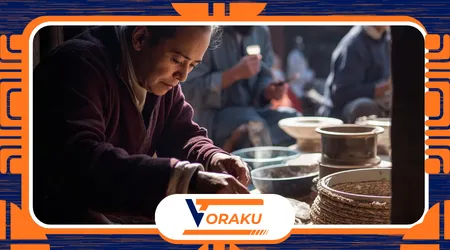
The phrase Ordinary Habits Preserve Ancient Traditions reveals itself in moments so mundane they barely register—like the quiet choreography of a dinner table at the end of a long day.
Someone tears bread instead of slicing it. Another reaches across without asking, as if guided by something older than etiquette.
No one pauses to question it.
No one explains it. And yet, something ancient is being repeated with quiet precision.
Traditions are often imagined as deliberate acts—ceremonies preserved with intention, rituals protected from erosion.
That image is comforting, but misleading.
Most traditions don’t survive because they are remembered.
They survive because they are absorbed, flattened into routine, stripped of explanation.
And once that happens, they become difficult to see.
Continue reading the text and learn more!
Table of Contents
- The Invisible Thread Between Routine and History
- Why Do Habits Outlive the Cultures That Created Them?
- Bread, Time, and the Subtle Architecture of Society
- What Rarely Gets Discussed About Everyday Rituals
- How Power, Religion, and Labor Quietly Script Behavior
- A Comparative Snapshot of Habit Persistence
- What Changed When Habits Became “Personal”
- FAQ: Ordinary Habits and Hidden Histories
Why Do Habits Outlive the Cultures That Created Them?
There’s a quiet efficiency to habits that rarely gets enough attention. They reduce friction.
They spare us from constant decision-making. Once embedded, they operate like background code—rarely visible, but always running.
This is where Ordinary Habits Preserve Ancient Traditions stops sounding poetic and starts sounding structural.
A behavior doesn’t need meaning to survive. It needs usefulness—or at least the memory of usefulness.
Over time, even that memory fades, but the structure remains. What’s left is a pattern with no obvious origin, quietly shaping behavior.
Consider something as unremarkable as eating three meals a day.
It feels natural, almost biological, as if the body itself demands it. But the historical record tells a more awkward story.
Meal structures hardened during the industrial era, when factory schedules required predictable breaks.
Hunger didn’t change. Time did.
Factories imposed rhythm. Workers adapted.
And adaptation, once repeated long enough, begins to feel like preference.
That’s the sleight of hand: what begins as constraint slowly disguises itself as choice.
++ Why Certain Colors Became Gendered
There’s something slightly unsettling in that transformation.
++ How Breakfast Became a Cultural Institution
Bread, Time, and the Subtle Architecture of Society
Bread offers a more tactile example—something that can still be held, torn, shared.
In medieval Europe, bread wasn’t just sustenance. It was a marker. Texture, color, even density signaled social hierarchy.
Dark, coarse loaves belonged to those who worked the land. Lighter, refined bread circulated among those who owned it.
But there’s a smaller detail that tends to slip past most accounts: bread was often shared because it had to be.
Large communal ovens meant loaves were baked in bulk. Breaking bread wasn’t symbolic. It was efficient.
Efficiency, however, has a way of hardening into meaning.
++ Why We Knock on Doors Before Entering
Over time, the act of sharing bread began to signal trust, hospitality, even moral decency. What started as logistics became social language.
And now? The gesture lingers, detached from its original necessity. Few people think about ovens or class divisions when passing bread across a table.
This is how Ordinary Habits Preserve Ancient Traditions—not by preserving context, but by preserving motion.
What Rarely Gets Discussed About Everyday Rituals
There’s a tendency to treat daily behaviors as expressions of personality. Preferences. Choices. Small declarations of identity.
That interpretation doesn’t quite hold up under scrutiny.
Why do people shake hands instead of bowing?
Why does punctuality carry moral weight in some cultures but not others?
Why does the concept of a “weekend” feel so natural, as if it were always there?
Each of these habits emerged under very specific pressures:
Handshakes signaled safety—the absence of weapons in uncertain environments.
Punctuality grew out of industrial discipline, where minutes could be measured and monetized.
Weekends were negotiated pauses, shaped by religious observance and labor resistance.
What rarely gets discussed is how completely these origins have faded from view.
The phrase Ordinary Habits Preserve Ancient Traditions points to something slightly paradoxical: the more ordinary a habit becomes, the less likely people are to question it.
Familiarity doesn’t just breed comfort—it erases curiosity.
How Power, Religion, and Labor Quietly Script Behavior
Habits don’t emerge in a vacuum. They are shaped—often quite deliberately—by institutions with the power to impose structure.
Religious systems have historically been among the most effective architects of daily life.
They didn’t just define belief; they organized time.
Prayer schedules, dietary laws, days of rest—these weren’t abstract guidelines.
They structured entire societies, down to the rhythm of a week.
Even for those far removed from religious practice, traces remain.
The seven-day cycle persists with remarkable stubbornness, long after its original framework has loosened.
Labor systems leave similar imprints.
The idea of a “morning routine” feels personal, even intimate. But its roots are far less romantic.
Waking early, structuring the day around fixed hours—these patterns were shaped by necessity, not preference. Light, labor, coordination.
Over time, these imposed rhythms were internalized. What was once enforced became habitual. Then it became invisible.
There’s a pattern here that is often softened in public discourse: authority rarely needs to maintain control forever.
It only needs to last long enough for behavior to become self-sustaining.
That is the quieter mechanism behind Ordinary Habits Preserve Ancient Traditions.
A Comparative Snapshot of Habit Persistence
| Habit | Historical Origin | Original Function | Modern Interpretation |
|---|---|---|---|
| Handshaking | Ancient Greece | Signal no weapons | Basic greeting |
| Three meals a day | Industrial Revolution | Structure labor time | Health norm |
| Weekends | Religious + labor systems | Rest and worship | Personal time |
| Queueing | Urban Britain | Maintain public order | Fairness |
The table simplifies things, perhaps too neatly. Real life is messier. Habits overlap, mutate, drift.
Still, the pattern holds: necessity becomes structure, structure becomes expectation, expectation becomes culture.
And culture, once settled, resists interrogation.
What Changed When Habits Became “Personal”
There’s a turning point—subtle, difficult to date—when habits stopped being seen as shared frameworks and started being framed as personal choices.
That shift matters more than it appears.
Once a behavior is interpreted as “mine,” it becomes harder to question.
It feels internal, authentic, self-generated. But in many cases, that sense of ownership is inherited.
A person might insist they prefer eating at a certain hour, or feel irritated by lateness, or default to a particular greeting. These feel like personal inclinations.
But they rarely originate there.
The phrase Ordinary Habits Preserve Ancient Traditions exposes that gap between perception and origin.
It suggests that much of what feels individual is, in fact, collective memory—filtered, diluted, but still present.
There’s something quietly destabilizing about that realization.
A Human Lens: A Worker in Transition
Picture a young factory worker in late 19th-century London.
He wakes before sunrise, not out of discipline, but because bells demand it. His breakfast is quick—bread, tea, something to carry him through the first stretch of labor.
Time isn’t his to negotiate. It’s measured elsewhere, enforced externally.
At first, the rhythm feels imposed. Abrasive.
But repetition does its work.
Weeks pass. Then years. The structure begins to feel less like pressure and more like order. Meals fall into place. Sleep follows a pattern. Disruption becomes uncomfortable.
Eventually, he raises children within that rhythm. Not as instruction, but as normal life.
By the time the next generation inherits it, the origin has faded. There are no factory bells in the story anymore.
Only habit.
This is the quieter machinery through which Ordinary Habits Preserve Ancient Traditions. Not through preservation, but through absorption.
The Quiet Resilience of the Ordinary
Attention tends to gravitate toward rupture—revolutions, inventions, sweeping cultural shifts.
Those moments are easier to narrate. They have edges, dates, protagonists.
But continuity works differently. It hums along in the background.
In kitchens. In greetings. In the unnoticed structure of a day.
These spaces rarely announce themselves as historical. They don’t need to. Their power lies in repetition, not visibility.
The phrase Ordinary Habits Preserve Ancient Traditions captures that quiet persistence.
It suggests that the past isn’t just remembered in archives or monuments. It’s enacted—casually, repeatedly, without ceremony.
And perhaps that’s why it lasts.
FAQ
Are habits always linked to historical conditions?
Not always directly, but many are shaped by past environments, constraints, or systems that no longer exist in the same form.
Why do these origins disappear over time?
Because habits are meant to operate automatically. Once a behavior becomes routine, its explanation becomes unnecessary—and eventually forgotten.
Can a habit exist without meaning?
Yes. In fact, many do. The structure survives even when the original purpose no longer applies.
Do new habits follow the same pattern?
They tend to. What begins as convenience often becomes routine, then expectation, and eventually something that feels permanent.
Is it possible to recognize these patterns in daily life?
It requires attention. Most habits are designed to go unnoticed, which is precisely why they endure.
++ Preserving Culture: A Guide To Keeping Traditions Alive
++ Cultural Sustainability: Keeping Traditions Alive in a Changing World
