
Why Ancient Athens Would Be Unrecognizable to Us

The sun beat down on the limestone of the Pnyx, a rocky hill just a short walk from the Acropolis, as thousands of men jostled for a seat.
Their voices rose in a low roar of gossip, grievances, and calculated political maneuvering. There was no air conditioning, no digital voting systems, and certainly no professional politicians in silk suits.
If you were a citizen, you were the government. You didn’t vote for a representative; you were the representative.
Yet, as the “Scythian archers”—the city’s peculiar police force of enslaved men—swept through the Agora with a rope dipped in red wet paint to herd stragglers toward the assembly, the exclusionary nature of this “cradle of democracy” became visible in the streaks of red left on the tunics of those who tried to skip their civic duty.
This was ancient Athens in its rawest form: a mix of radical participation and coercive exclusion.
Did the Greeks actually believe in equality?
When we invoke ancient Athens in modern political speeches, we tend to paint it as a shimmering marble utopia of free speech and egalitarianism.
We imagine a society of philosophers debating in clean tunics. But the reality I’ve found in the dusty corners of social history is far more visceral and, frankly, far more uncomfortable.
The Athenian definition of “the people” (demos) was surgically, almost brutally, precise. It wasn’t about universal human rights; it was about a closed club of privileged insiders.
To be a citizen, you had to be a male, born of two Athenian parents, and over the age of eighteen.
This effectively barred about 80% to 90% of the population. Women, metics (resident aliens), and an enormous population of enslaved people provided the grueling labor and the domestic stability that allowed the “free” men to spend their afternoons arguing about naval triremes and grain imports.
In my analysis, we shouldn’t look at Athens as a precursor to our modern liberal democracies, but rather as an elite boardroom that happened to include about 30,000 shareholders.
It was a democracy of the elite, by the elite, for the elite.
+ The Hidden Economic Forces Behind the American Civil War
The radical—and dangerous—nature of the lot
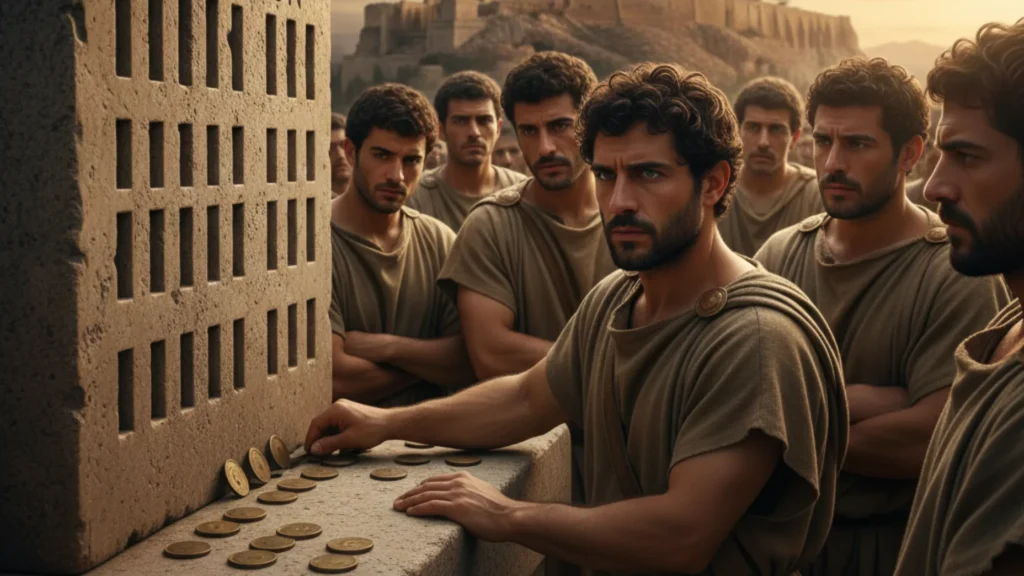
What rarely is discussed—and what genuinely baffles the modern mind—is that the Athenians would find our contemporary system of “elections” fundamentally undemocratic.
To them, voting for a person was an aristocratic practice because it naturally favored the wealthy, the famous, and the eloquent. Instead, they relied on a machine called a kleroterion.
This stone slab with precisely carved slots was used to randomly select officials by lot. Imagine if, instead of voting for a Senator, we simply pulled names out of a hat from the entire local census.
That was the daily reality of ancient Athens. It was a system built on the radical, perhaps terrifying, belief that any citizen was capable of holding any office.
While this created a level of civic engagement we can’t even dream of today, it also invited a disastrous volatility.
When the “mob” gets to decide military strategy on a whim after a charismatic speaker gets them riled up, you end up with catastrophes like the Sicilian Expedition, where thousands died because of a collective rush of blood to the head.
+ Why the Fall of the Roman Republic Was More Inevitable Than We Think
Why did this system emerge in the first place?
The shift toward this radical participation didn’t happen because the Greeks were more “enlightened” than their neighbors.
It was a matter of cold, hard leverage. When warfare moved from elite chariot-driving aristocrats to the “hoplite” phalanx—massed ranks of middle-class infantry—those men began to demand a seat at the table.
If they were the ones bleeding in the dirt for the city, they were going to be the ones deciding when the city went to war.
The social force at play wasn’t “humanity”; it was political necessity. According to records curated by the Perseus Digital Library, the tension between the few (oligoi) and the many (polloi) was the heartbeat of the city.
Democracy was a pragmatic truce, a way to keep the city from tearing itself apart in a bloody civil war. It was peace through participation.
A Day in the Life: The Trial of a Stone
To understand the Athenian mind, you have to look at their obsession with accountability, which reached levels that border on the absurd.
There is a detail that often passes unnoticed: the Athenians were so committed to the idea of “agency” that they held trials for inanimate objects.
If a stone fell from a building and killed someone, the stone was put on trial, found guilty, and cast beyond the city borders.
This reveals a society that viewed justice not as an abstract moral code, but as a physical cleansing of the community.
In ancient Athens, the individual was nothing; the polis (the city-state) was everything. This is why “ostracism” existed.
Once a year, citizens could write the name of a person they found “too powerful” or simply too annoying on a piece of broken pottery (ostrakon).
If enough people agreed, that person was vanished for ten years. No crime was necessary. Being “too much” was enough to get you kicked out. It was the ultimate social audit.
How the ghost of Athens haunts our digital squares
When we look with more attention, the pattern repeats in our modern digital discourse. The Athenian Agora was a place of high-stakes reputation.
Your standing was your currency, and a single bad speech could end your career or your life.
Our modern social media platforms have, in a strange twist of history, returned us to a more “Athenian” style of justice: swift, emotional, decentralized, and often lacking in what we now call “due process.”
There is a profound irony here. We spent centuries building “Representative Democracy” to protect ourselves from the volatility of the Athenian “Direct Democracy.”
We built barriers—courts, senates, constitutions—to slow things down. But the internet has stripped those barriers away, placing us back on the Pnyx, where the loudest voice in the crowd can steer the ship of state before the sun sets.
The “mob” is back, and it’s just as fickle as it was 2,500 years ago.
What changed after the fall of the City-State?
| Feature | Ancient Athenian “Democracy” | Modern Liberal Democracy |
| Who votes? | Adult male citizens only (approx. 15% of pop). | Universal suffrage (all adult citizens). |
| Selection | Random lottery for most offices. | Competitive elections for representatives. |
| Individual Rights | Subordinate to the needs of the city. | Protected by constitutions and human rights. |
| Slavery | Essential economic foundation. | Illegal and morally condemned. |
| Communication | Direct oratory in a physical space. | Digital, mass media, and representative. |
The uncomfortable truth about “Freedom”
The reading most honest of this phenomenon suggests that the Athenian “Golden Age” was bought and paid for by the sweat of the disenfranchised.
To maintain a state where 30,000 men could spend their mornings debating philosophy in ancient Athens, someone had to be working the silver mines of Laurium under horrific conditions.
We like to think of democracy as a natural evolution toward light, but in its first iteration, it was a high-walled garden.
The “freedom” of the Greek citizen was a status symbol, not a universal right. It was defined specifically by what you were not: you were not a woman, you were not a foreigner, and you were not a slave. Exclusion wasn’t a bug in the system; it was the main feature.
The recurring pattern of the “In-Group”
There are good reasons to question the narrative that we are the direct heirs of Cleisthenes or Pericles.
Our modern world is built on the Enlightenment principles of the 18th century, which sought to protect the individual from the state.
Athens, conversely, sought to make the individual the state. The two concepts are often at odds.
When we see the rise of populism today, we are seeing a ghost of the Athenian assembly. People are tired of representatives; they want to be the ones holding the red-painted rope.
They want the direct, raw power that existed in ancient Athens. But we must ask ourselves: are we willing to accept the volatility, the ostracisms, and the lack of individual protections that come with it?
History doesn’t repeat, but it certainly rhymes in the way we handle power and exclusion. The Athenian experiment ended not because it was “wrong,” but because it was fragile.
It couldn’t survive the pressures of long-term war and the rise of professional empires. As noted by the Metropolitan Museum of Art’s historical essays, the visual legacy of Athens—its columns and statues—gives us a sense of permanence that the actual political system never had. It was a constant, messy, loud, and often violent negotiation.
Frequently Asked Questions
Why did Athens use a lottery instead of voting?
They believed that elections were inherently biased toward the rich and famous. A lottery (sortition) ensured that every citizen had an equal chance to serve, preventing the rise of a permanent political class of “experts” or elites.
Could women ever participate in the Athenian government?
No. Women were legally “minors” under the guardianship of their male relatives. They had no vote and no right to own property in their own name, despite being essential to the city’s religious and domestic life.
Was slavery really that common in Athens?
Yes. Estimates suggest there were between 60,000 and 100,000 enslaved people in Athens at its peak. They performed everything from domestic work to specialized roles like bookkeeping. Without their labor, the “leisure” required for democracy would have been impossible.
What was “Ostracism”?
It was a democratic process where citizens voted to exile someone from the city for ten years. It wasn’t a punishment for a crime; it was a preventative measure to stop any one person from becoming too influential or threatening the balance of the city.
How long did the Athenian democracy last?
It lasted roughly 200 years, from about 508 BCE to 322 BCE. While it feels eternal in our history books, it was a relatively brief experiment that ultimately succumbed to the rise of Macedonian power.
The lessons of ancient Athens aren’t found in the speeches we’ve sanitized for textbooks. They are found in the tension between the desire for total participation and the reality of total exclusion.
We are still trying to solve the puzzle they started: how to create a society that is truly governed by “the people” without turning into a mob that casts stones at anything it doesn’t understand.
