
How the Printing Press Triggered the First Information Revolution
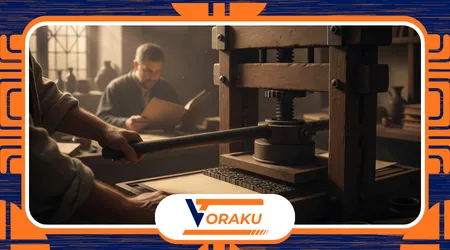
The first information revolution didn’t begin with a grand manifesto or a digital pulse; it started with the rhythmic, bone-jarring thud of a modified wine press hitting a sheet of dampened paper in a cluttered, debt-ridden workshop in Mainz.
Johannes Gutenberg wasn’t a visionary aiming to topple the divine right of kings or dismantle the Catholic Church’s monopoly on the human soul.
He was a goldsmith with a mounting pile of legal troubles and a relentless, almost frantic obsession with mechanical precision.
Around 1450, as he experimented with lead alloys and oil-based inks, the world outside his window was defined by a terrifying, stagnant silence.
Information moved at the agonizing speed of a horse. Knowledge was a physical object—locked away in monastic scriptoria, hand-copied by monks whose eyesight usually failed long before they finished a single tome.
Back then, a book didn’t just cost money; it cost as much as a functioning farm.
What Gutenberg actually did was turn the “word” into an industrial product. In doing so, he didn’t just invent a machine; he accidentally built the centrifuge that would spin the Middle Ages apart.
Why a modified wine press changed the architecture of thought
We often treat the printing press as a simple triumph of literacy, but that is a sanitized, classroom version of a much more violent shift.
To grasp the gravity of the first information revolution, we have to look at the psychological mutation it forced upon the human brain.
Before the 15th century, memory was a vital muscle. If you didn’t memorize a sermon, a law, or a recipe, it effectively ceased to exist for you the moment the speaker stopped talking.
When the press arrived, knowledge was externalized. It became “fixed.” For the first time, two people hundreds of miles apart could look at the exact same sentence, the exact same woodcut diagram, or the exact same map without the drift of human error.
This created a new kind of “public square”—not a physical location like the Roman Forum, but a borderless intellectual space where ideas could collide and cross-pollinate without the authors ever meeting.
The social forces at play were volatile and ripe for disruption. Europe was slowly exhaling after the horror of the Black Death, which had ironically left the survivors wealthier and more urbanized.
There was a desperate, grumbling hunger for practical knowledge—how to navigate the open seas, how to keep double-entry accounting ledgers, how to treat a fever.
The Church held the keys to the library, but the rising merchant class held the coins. Gutenberg’s press met that market demand, and in the process, it stripped the elite of their role as the sole gatekeepers of reality.
+ The Silent Power of Social Conformity Explained by Research
The detail we usually ignore: The invention of the “Standard”

What rarely gets discussed is how the printing press essentially manufactured the concept of a national identity out of thin air.
Before the press, “Germany” or “England” were vague geographical concepts. People spoke in local dialects that shifted every twenty miles; a peasant in Cornwall could barely understand a merchant in London.
There was no “standard” tongue, only the way the people in your specific valley spoke.
When printers started churning out books, they faced a cold economic reality: they needed the largest possible market to turn a profit.
They couldn’t afford to print a different version of a book for every village dialect. So, they picked a dominant version—usually the one spoken in the capital or the busiest trade hub—and standardized it.
If you lived in the provinces and wanted to read the news or the law, you had to learn the “standard.”
By fixing language on a page, the press “invented” the Frenchman and the Englishman. It drew linguistic borders long before kings had the cartographic tools to draw them on maps.
This was the silent engine of nationalism, a byproduct of a businessman trying to scale his inventory.
+ The Overlooked Role of Climate in the Collapse of the Maya Civilization
How one monk accidentally broke the global system
The most famous beneficiary of this first information revolution was Martin Luther, but there’s a nuance to his success that mirrors our current social media cycles in an unsettling way.
Luther wasn’t the first person to have legitimate gripes with the Vatican; he was just the first one who had access to a viral distribution network.
Imagine a young university professor in 1517, frustrated by the blatant corruption he sees. In a previous century, his “95 Theses” would have been a local dispute, settled quietly by a bishop or lost to the dust of history.
Instead, local printers saw Luther’s provocative text and realized it was “clickbait” (in 16th-century terms).
They translated his Latin into the common German tongue, printed thousands of copies, and flooded the markets of Europe in mere weeks.
The Church, used to the slow, manageable pace of traditional dissent, simply couldn’t move fast enough to burn the books before they were read.
By the time the authorities reacted, the “post” had already gone viral. This is the pattern we see repeated in every era: technology outpaces the law, and by the time the establishment tries to regulate the medium, the message has already reshaped the cultural landscape.
+ The Hidden Economic Forces Behind the American Civil War
What changed after the Press?
| Feature | Pre-Gutenberg Society | Post-Gutenberg Society |
| Data Storage | Fragile human memory and rare manuscripts | Mass-produced, durable libraries |
| Authority | Based on status and “divine” tradition | Based on evidence and the cited text |
| Language | Hundreds of localized, fluid oral dialects | Standardized, rigid national languages |
| Truth | Centralized (The Church/The Crown) | Decentralized (The Marketplace of Ideas) |
Are we just repeating the 16th century?
When we look at the chaos of the internet—the misinformation, the echo chambers, the rapid collapse of institutional trust—the pattern repeats with haunting accuracy.
It’s worth noting that the first information revolution didn’t lead to an immediate era of enlightenment and peace. It led to a century of brutal religious wars.
When you give everyone a voice, the first thing they often do is use it to scream at one another.
The printing press allowed for the distribution of the Bible, yes, but it also fueled the mass distribution of manuals on how to identify and hunt witches. It democratized the best of us and the worst of us simultaneously.
There is a fundamental human anxiety that arises when the “cost of speaking” drops to zero.
In the 1500s, the gatekeepers were the clergy; today, they are the editorial boards and the tech giants. In both cases, the revolution felt like a loss of control.
On my analysis, we aren’t living through something entirely “new” in the digital age; we are simply experiencing the second act of the play Gutenberg started.
We are still learning how to live in a world where the volume of information far exceeds our capacity to filter it.
The human cost of the “Correct” version
Consider the life of a rural physician in the late 1600s. Before the press, he relied on folk remedies, perhaps a few Latin phrases he’d overheard, and a great deal of intuition.
With the first information revolution, he could suddenly order a copy of The Philosophical Transactions of the Royal Society, the world’s first scientific journal.
He could read about the circulation of blood or the discovery of microscopic cells. But there was a trade-off.
To be a “real” doctor, he now had to be literate. He had to keep up with “the literature.” The informal, oral wisdom of his community—centuries of trial and error—was suddenly dismissed as “superstition” because it wasn’t printed.
The press created an obsession with “expertise” that redefined social classes. If you weren’t in the loop of the printed word, you were effectively invisible to history.
Why does this legacy still matter?
There’s a reason we still talk about “the press” even when we are staring at a liquid-crystal display.
It’s because the printing press established the foundational logic of the modern world. It taught us that information should be free, that it should be verifiable, and that it should belong to the public rather than the palace.
The reading habits we formed in the 17th and 18th centuries—the long-form essay, the investigative report, the political pamphlet—shaped the democratic revolutions in America and France.
Without the cheap, mass-produced pamphlet, there is no Thomas Paine; without Thomas Paine, the ideological fire of 1776 might have been a mere flicker.
We often credit “Great Men” for the march of history, but the more honest reading of this phenomenon suggests that history is actually driven by the tools that allow men to talk to one another.
Gutenberg didn’t create the Reformation or the Enlightenment, but he provided the bandwidth that made them inevitable.
FAQ: Editorial Perspective
1. Did the printing press make everyone literate immediately?
Hardly. Literacy rates remained low for decades, but the functional impact of literacy grew. Even if a peasant couldn’t read, someone in the local tavern or church could. They would read the news or the Bible aloud, meaning the information reached the masses even if the ability to decode the symbols didn’t.
2. Was the Church actually against the printing press?
It’s a fascinating contradiction. Initially, the Church embraced it as a way to produce consistent Bibles and missals. They saw it as a tool for divine order. It was only when the press began to be used for “heresy” (like Luther’s German translation) that the Vatican realized they had accidentally funded their own disruption.
3. How long did it take for the press to actually change the world?
It wasn’t an overnight flip of a switch. It took about 50 years—roughly one generation—for the density of printed material to reach a “tipping point” where it started to fundamentally alter the structures of politics and science.
4. What was the “internet” of the 1500s?
The “broadside” or “pamphlet.” These were single sheets of paper, cheaply printed and sold on street corners for a pittance. They were the ancestors of the blog post or the viral tweet—quick, often heavily biased, and designed to spread as fast as humanly possible.
5. Why do we call this the “First” Information Revolution?
Because it was the first time in human history that the reproduction of knowledge was mechanized. Before this, every “copy” of a thought required a human hand and hundreds of hours of labor. The press was the first step toward the instant, infinite copying we do today with Google and the wider web.
The first information revolution reminds us that whenever we change how we communicate, we change who we are.
We are currently fumbling through the digital era, wondering why our institutions are shaking and our certainties are crumbling.
If we look back at the ink-stained hands of those 15th-century printers, we might find some cold comfort. They, too, felt like the world was ending—when, in fact, a new one was just being proofread.
