
The Forgotten Conflicts That Shaped Borders
Imagine a soldier alone in the Gran Chaco, 1933.
Canteen long empty, tongue swollen, the heat bending the thorn bushes into mirages while artillery mutters somewhere beyond the next rise.
No flags snapping in heroic wind, no correspondents scribbling dispatches for the front page—just another man dying slowly over dirt nobody wanted until someone decided it was worth everything.
The Forgotten Conflicts That Shaped Borders live in landscapes like that one.
Harsh, peripheral places where maps feel abstract until the shooting starts and the dying begins.
Continue reading our article to learn more!
Table of Contents
- Why These Wars Fade from Memory
- What Hidden Forces Ignited These Border Clashes?
- How Did the War of the Pacific Redraw South America’s Map?
- Can a War Be Too Devastating to Remember? The Paraguayan Catastrophe
- What Happens When Thirst Becomes a Weapon? The Chaco War’s Brutal Legacy
- Why Do Modern Borders Still Bleed? Lessons from Eritrea and Ethiopia
- FAQ Editorial
Why These Wars Fade from Memory
We remember the wars that reordered the entire chessboard. These? Quiet regional hemorrhages, fought in places wire services rarely bothered to reach.
Contemporary coverage was thin; textbooks still sprint past them toward more photogenic carnage.
Yet peer beneath the surface and the tempo is depressingly familiar: trivial sparks, rapid escalation, massive but localized suffering, then a new line on the map and a long silence.
The people caught inside remain the sharpest memory.
Usually not ideologues—just farmers handed rifles, pastoralists whose seasonal routes became killing zones.
I’ve heard their grandchildren in fading border towns explain, matter-of-factly, why a barbed-wire fence now separates first cousins.
One thing almost always gets left out of the telling: these fights brutally exposed the fiction of early nationhood.
++ The Lost Voices Behind Famous Historical Moments
Distant capitals claiming enormous, barely administered spaces their own populations scarcely recognized—planting structural humiliations that sink roots and refuse to die.
++ How Power Determines Which Stories Survive
What Hidden Forces Ignited These Border Clashes?
Pride, plunder, old scores that never quite settled.
Leaders hungry for a quick, cheap victory to steady shaky domestic ground.
Beneath the surface ran thicker, less heroic currents: ethnic mistrust, commercial envy, foreign concession-hunters whispering promises of wealth.
++ The Hidden Role of Minor Figures in Major Events
That last part rarely gets the attention it deserves.
These weren’t always pure contests of national honor; sometimes they were the ragged frontier edges of early global capitalism.
Soldiers suffered far more from cholera, malaria, thirst than from aimed bullets—the landscape itself became a combatant.
The pattern carries forward: today’s border frictions in the Sahel or along the Himalayas stir exactly the same toxic blend of ego, scarcity, and outside opportunism.
How Did the War of the Pacific Redraw South America’s Map?
The War of the Pacific (1879–1884) was resource theft wearing the mask of national destiny.
Chile against Bolivia and Peru for control of the Atacama’s nitrate fields—the era’s equivalent of strategic petroleum.
A Bolivian tax on Chilean mining operations in Antofagasta lit the match.
Chile responded by seizing the port city outright. Peru, bound by a secret defensive pact, entered the fray.
At sea Chile’s ironclads dominated; the capture of Peru’s Huáscar off Angamos was especially savage.
On land Chilean forces swept north, occupied Tacna and Arica, then sacked Lima itself in 1881, looting the national library among other treasures.
The treaties that followed were merciless: Chile annexed Tarapacá outright and took Antofagasta from Bolivia, condemning the latter to permanent landlocked status.
Arica remained Chilean until 1929; Tacna was eventually returned to Peru. The body count approached 25,000.
Economies collapsed. Families were torn apart. Bolivia turned the loss of the sea into a permanent national wound—naval ceremonies are still held in landlocked plazas every March.
Chile converted nitrate wealth into railroads, schools, a modern navy. The resentment still clouds water negotiations, trade agreements, every formal meeting between the neighbors.
| What Changed After This? | Before | After |
|---|---|---|
| Bolivia’s Geography | Pacific ports, nitrate income | Landlocked, permanently dependent |
| Chile’s Regional Power | Solid but secondary | Nitrate boom funds dominance |
| Andean Relations | Tense but workable | Structural distrust, legal battles |
| Human Legacy | Mixed border communities | Scattered families, founding myths |
Can a War Be Too Devastating to Remember? The Paraguayan Catastrophe
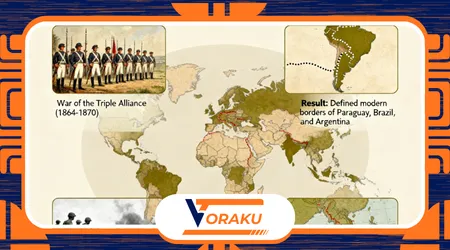
The Paraguayan War (1864–1870) stands in a category of horror almost by itself.
Francisco Solano López’s Paraguay against the Triple Alliance of Brazil, Argentina, and Uruguay—a wildly overconfident bid for regional stature.
A seized Brazilian steamer and Paraguayan incursions into Mato Grosso and Corrientes triggered the spiral. López disastrously underestimated his enemies.
Tuyutí was apocalyptic—18,000 casualties in a single day. The Paraguayan navy was destroyed at Riachuelo.
Humaitá fortress endured months of siege. López retreated inland, eventually conscripting boys as young as ten and women into auxiliary roles. He was killed at Cerro Corá in 1870, still in the field.
Paraguay lost perhaps half its population to combat, starvation, and epidemic—though more restrained estimates still place the demographic catastrophe in the tens of thousands.
Women and children rebuilt under foreign occupation.
The country shrank by roughly 40 percent. Globally the war was overshadowed by the American Civil War; locally it saturated memory—epics, laments, novels, even a noticeable gender imbalance that lasted generations.
Hubris broke the nation; sheer survival temper-hardened it.
The lost territories still feed a low, persistent irredentism.
What Happens When Thirst Becomes a Weapon? The Chaco War’s Brutal Legacy
The Gran Chaco War (1932–1935) was fought over a waterless, thorn-choked nowhere both Bolivia and Paraguay claimed for rumored oil and strategic rivers.
Bolivia, still raw from losing the Pacific coast, desperately wanted an outlet to the Atlantic via the Paraguay River. Paraguay refused to yield its lifeline.
Sporadic fort-building incidents in 1928 escalated into open war in 1932. Bolivia’s initial thrust collapsed against Paraguayan knowledge of the terrain and ruthless guerrilla tactics.
Encirclements at Boquerón and other choke points devoured entire divisions.
Dehydration killed far more men than bullets—hence the nickname “War of Thirst.”
Paraguay emerged with three-quarters of the disputed Chaco in the 1938 treaty. Total casualties approached 100,000—a staggering price for two small countries.
No commercial oil appeared for decades.
Bolivia’s defeat helped catalyze the 1952 revolution and the rise of indigenous political power.
Paraguay basked briefly in victory but both nations carried deep social scars—displaced highland conscripts, ethnic tensions, traumatized generations.
Dismissed internationally as a provincial sideshow, the war effectively ended large-scale interstate conflict in South America for the rest of the twentieth century.
That long, uneasy peace is one of the few unadvertised successes to come out of so much suffering.
Why Do Modern Borders Still Bleed? Lessons from Eritrea and Ethiopia
In 1998 Eritrea—only seven years independent after a thirty-year liberation war—clashed with Ethiopia over Badme, a dusty border village sitting in a zone left ambiguous by Italian colonial maps.
Early post-independence cooperation had already soured over currency disputes and trade access.
Eritrea moved troops into Badme; Ethiopia declared full war.
The fighting settled into WWI-style trenches and human-wave assaults. Ethiopia’s May 2000 offensive broke through and occupied large swathes of Eritrean territory.
A 2002 arbitral award gave Badme to Eritrea, but Ethiopian forces remained in place until the surprise peace agreement of 2018.
Estimates of the dead range between 70,000 and 100,000. Mass expulsions occurred on both sides.
Child soldiers were used. Eritrea hardened into a highly militarized, inward-turning state; Ethiopia’s wounds contributed to later internal fractures, including the Tigray conflict.
Largely ignored outside the Horn of Africa, the war binds yesterday to today: forgotten border fights do not disappear.
They lie dormant, waiting for the next economic pressure or political miscalculation to reopen them.
These half-remembered wars force us to look twice at the maps pinned to every classroom wall.
They are not clean lines of reason; they are the last places exhaustion, greed, and pain could reach before everything stopped moving.
When the next quiet dispute flares in some overlooked valley, perhaps we’ll remember that the silence that follows is rarely permanent.
Forgotten Conflicts That Shaped Borders: FAQ
What makes these conflicts “forgotten” compared to major wars?
They stayed regional, lacked global stakes, and never attracted sustained media oxygen.
The border changes they produced arrived quietly and reshaped lives without ceremony.
How do these wars still affect daily life in the regions?
Bolivia’s missing coastline inflates every import, drives migration south, and keeps politics permanently tinged with grievance.
Sea Day marches are not folklore; they are living memory.
Is there a pattern in why these border disputes erupt?
Resource hunger collides with sloppy colonial cartography and ethnic overlaps. Ambiguous lines plus short tempers equal rapid combustion.
Could similar forgotten conflicts happen today?
They already are—Arctic seabed claims, South China Sea reefs, Himalayan pastures. Same motives, twenty-first-century stakes.
Why focus on South America and Africa in examples?
Both continents carry the deepest scars of colonial partition.
Their border wars are the clearest, most painful illustrations of how yesterday’s careless lines still bleed into tomorrow.
Are there any positive outcomes from these wars?
Very few, and always hard-won. Bolivia’s 1952 revolution grew partly from Chaco humiliation. Paraguay discovered a stubborn national resilience amid ruin.
Thin silver threads running through very dark cloth.
++ Between Borders and Fear: Everyday Life in a Forgotten Conflict in Central Asia
