
The Origins of Queuing and Waiting Lines
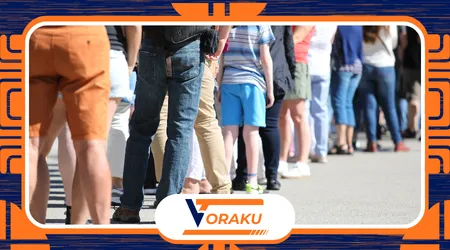
I was jammed shoulder-to-shoulder with strangers outside a narrow Paris bakery one gray morning last year when the thought finally landed.
The line snaked along the pavement in perfect, wordless order—everyone rocking from foot to foot, eyes averted or glued to phones, yet nobody shoving, nobody shouting.
It felt so normal I almost missed how strange it really was.
And yet there we stood, accepting our places as if some invisible hand had drawn the chalk marks centuries ago.
The origins of queuing and waiting lines hide in exactly those moments: ordinary scenes that quietly rewrote how strangers share scarce things.
Before the early nineteenth century, most crowds around bread, tickets, or water were a mess of elbows, status, and raw noise.
The single-file line we know today didn’t drift down from ancient habit.
It was hammered into shape when cities exploded, clocks started ruling wages, and fairness suddenly had to be visible to everyone at once.
Continue reading the text!
The Road Map
- The First Documented Queues in Revolutionary France
- Industrial Revolution: Birth of the Modern Queue
- World Wars and the Making of National Myth
- Human Example: A Day in the Life of a 19th-Century Worker
- Comparative Historical Table
- Queues in the Digital Age
- FAQ Editorial
When Did the First Orderly Lines Actually Appear?
Thomas Carlyle, the Scottish historian, stood in Paris in 1837 and found the sight odd enough to write home about it: French citizens standing patiently in rows outside bakeries during the Revolution.
He called it a “queue,” borrowing the old French word for an animal’s tail.
What strikes me as odd is how rarely we pause on that detail.
Carlyle wasn’t watching primitive instinct; he was watching a brand-new social invention being born in real time.
Revolutionary shortages had turned every loaf into a potential riot.
Urban streets were packed tighter than ever. The old way—push, bribe, or send a servant—no longer worked when thousands of hungry strangers shared the same narrow sidewalk.
The line became a quiet political statement: first come, first served, no exceptions for birth or sword.
There’s something unsettling here. The queue didn’t arrive because people suddenly grew polite. It arrived because chaos had become too expensive.
++ Why Chairs Were Once Symbols of Authority
How Did the Industrial Revolution Force Us Into Line?
Walk with me into Manchester around 1840. Dawn is still thin, yet already a hundred workers stamp their boots outside the factory gates. Inside, the foreman’s clock is merciless.
Arrive late and you lose half a day’s pay. That same iron discipline leaked into every public space—omnibuses, soup kitchens, post offices.
Rural life had let people drift by the sun; city survival ran on minutes.
The forces at work were both brutal and invisible.
++ The Cultural Evolution of Personal Hygiene
Population surged. Wages replaced barter. A rising middle class, armed with etiquette manuals and sharp tongues, began enforcing “taking your turn” as proof of respectability.
What changed after that shift still ripples through us.
Waiting stopped feeling like humiliation and started feeling like a shared civic duty.
I’ve covered enough social fractures over the years to recognize the pattern: the queue quietly taught millions that patience could be a form of power.
Older civilizations never managed anything like it. Roman grain handouts turned into shoving matches laced with bribery.
Egyptian temple crowds or Mesopotamian bazaars ran on loud negotiation and family muscle.
The orderly line needed two new ingredients—anonymous city density and the fragile idea that strangers might actually deserve equal turns.
Those ingredients only arrived when steam engines and factory whistles rewrote daily time itself.
++ The History of Timekeeping in Daily Life
Why Do We Still Queue the Way Our Great-Grandparents Did?
By the Second World War the queue had been drafted into national service.
British posters turned standing in line for rations into a patriotic act. “Doing your bit” meant freezing in place while the world burned elsewhere.
The lines were often tense, full of muttered complaints and sharp elbows, yet the myth took root.
I still catch myself noticing the same contract today—at Heathrow security, at a Brooklyn deli, even at those chaotic Black Friday doors.
We grumble, we shift, we police the line-jumpers with a single raised eyebrow, yet we keep the faith.
The origins of queuing and waiting lines echo in every airport lane and every midnight release crowd because they remain one of the last purely human shields against pure efficiency.
Apps try to replace them with glowing numbers, but something in the body still wants the proof that other bodies are waiting too.
What Changed After the Queue Became Normal?
A fragile social treaty settled in. Public hierarchy softened, at least on the pavement.
The powerful kept their VIP shortcuts, of course, but ordinary people gained a new weapon: the quiet sentence “There’s a queue.”
That phrase carries two hundred years of accumulated resentment against unfairness.
Let me lay it out plainly, the way I’ve tracked it in notebooks for years:
| Period | How Access Worked | Driving Force | How It Felt to Wait |
|---|---|---|---|
| Pre-1800s | Push, status, shouting | Raw strength and favor | Tense, unpredictable |
| Industrial Era | Single-file order | Urban crush + wage clocks | Democratic on the surface |
| WWII & After | Enforced patience | Rationing + propaganda | Patriotic yet quietly angry |
| Digital Present | Physical + virtual mix | Algorithms + surveillance | Impatient but oddly nostalgic |
Each row marks a trade: brute force swapped for shared rules. The emotional weather of daily life changed with it.
Imagine a London Clerk in 1895
Picture Edward, a junior insurance clerk trudging up High Holborn every morning.
He knows the regulars by sight—the milliner clutching her hatbox, the docker still smelling of the river, the widow with her pension papers folded tight.
They exchange nothing more than nods, yet when a drunk tries to muscle forward, three voices rise at once: “End of the queue, if you please.”
Edward feels something larger than his own aching feet: a thin thread of solidarity among people who own nothing but their place in line.
That feeling traveled with every emigrant ship to America, Australia, anywhere the factories followed.
It explains why, even now, in cities full of languages we don’t share, the queue remains one of the few rituals that crosses every border.
The Queue in the Age of Algorithms
We’ve almost looped back to the beginning. Digital waiting rooms promise perfect fairness through code.
Yet the moment the servers crash or a new phone drops, we still see people sleeping on sidewalks in tidy rows.
The origins of queuing and waiting lines remind us that technology hasn’t erased the need for visible order—it has only made us crave the proof of it more.
There’s something bittersweet in that. The more invisible the system, the more our bodies remember the old choreography.
What the Queue Still Teaches Us About Ourselves
The honest truth is we romanticize the queue when it flatters us and curse it the rest of the time.
We praise British restraint while forgetting how that same patience once kept ration books moving during blitz nights.
We mock line-jumpers in other countries yet forgive our own small cheats at the coffee shop. That tension is exactly why the ritual refuses to die.
Every time we join a line we quietly affirm the smallest democratic act of all: the inch of pavement between one pair of shoes and the next.
The origins of queuing and waiting lines didn’t come from kings or philosophers.
They came from bakers running short on bread, foremen punching clocks, and millions of tired strangers deciding—against every older instinct—to wait their turn.
When the last physical queue finally vanishes, something tender will vanish with it: the unplanned glance, the shared sigh, the tiny victory of simply holding your ground.
Until then, the line keeps teaching us the same stubborn lesson: decency under pressure is rarely dramatic. It’s just the quiet agreement that we all, somehow, deserve our place.
++ Queuing: Is it really the British way?
Frequently Asked Questions
Is queuing really a British invention?
Not quite. The first clear records come from revolutionary France, and similar habits popped up wherever cities swelled.
Britain polished the etiquette and turned it into folklore during the wars, but the roots belong to every society that had to cram strangers together fast.
Why do some cultures queue more patiently than others?
It’s less about blood and more about history. Long experience with scarcity plus strong public enforcement tends to produce visible lines.
Other places use loud bargaining or family signals instead. Both approaches solve the same problem—how to share without fists.
Did ancient civilizations ever form lines?
Not the single-file kind we recognize. Roman grain days or Egyptian festivals involved waiting, but the records show pushing, bribes, and elite priority.
The modern queue needed urban anonymity and the idea of equal turns—two things that simply weren’t there yet.
Can technology kill the physical queue?
It’s trying hard. Virtual rooms and apps shrink the lines, but every time desire spikes or systems fail, people still sleep on sidewalks in orderly rows.
The body remembers what the algorithm forgets.
Why do we hate queues but keep joining them?
Because they’re both frustration and fairness in the same breath.
We resent the wait, yet we know that without the line the loudest or strongest would win every single time.
That inner tug-of-war is what keeps the ritual alive.
Will future generations still understand queuing?
They’ll probably queue differently—in virtual worlds or for digital drops—but the principle of turn-taking feels too useful to vanish.
The shape may change. The need won’t.
Next time you find yourself at the back of a long line, take a breath and look around.
You’re not just waiting for coffee.
You’re standing inside one of the quietest, most stubborn social inventions we ever made—an agreement that turned potential chaos into something almost tender: the shared promise that everyone gets their turn.
++ Queue area
