
Why the Fall of the Roman Republic Was More Inevitable Than We Think
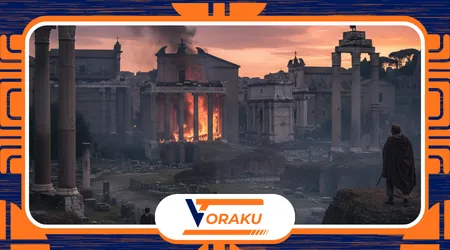
The dust in the Roman Forum didn’t just settle; it tasted of iron and old, festering grievances.
If you had stood near the Rostra in the winter of 52 BCE, you wouldn’t have seen a glorious civilization at its peak.
You would have smelled the charred timber of the Senate house burning to the ground. It wasn’t destroyed by a foreign invader or a sudden act of God.
It was torched by a grieving, rioting mob following the murder of Publius Clodius Pulcher—a man who had turned street thuggery into a legitimate political career.
Watching that smoke rise, a merchant or a slave might have felt a chillingly familiar sensation: the realization that the “rules” had simply evaporated.
The institutions were still there, the marble statues still stared blankly, and the magistrates still wore their purple-bordered togas with performative dignity.
But the soul had left the building. We often talk about the fall of the Roman Republic as a sudden tragedy, a Shakespearean betrayal on the Ides of March.
But after two decades of peeling back the layers of social collapse, it has become clear to me that the Republic didn’t fall because Caesar was ambitious.
It fell because the structural integrity of Roman society had already turned to sawdust.
Was the Republic a victim of its own success?
There is a seductive myth that republics die because of “bad actors.” We like this narrative because it’s easy to film; you just need a villain with a hooked nose and a hero with a conscience.
However, the reality is far more clinical and, frankly, more terrifying. The Roman Republic was originally designed for a city-state of farmers—a compact community where everyone knew the stakes and shared the risks.
By the time it conquered the Mediterranean, that system was being asked to run a global superpower.
It was like trying to manage a multinational tech conglomerate using the bylaws of a local gardening club. It was never going to hold.
What rarely is discussed—and what I find most telling—is the “Economic Tipping Point.” As Rome’s legions swallowed the world, they brought back millions of enslaved people.
This wasn’t just a human rights horror; it was a macroeconomic wrecking ball. Small-scale Roman farmers, the very men who fought the wars, returned home to find they couldn’t compete with the massive latifundia worked by free slave labor.
They lost their land, drifted to the city, and became the “urban mob.”
The social contract wasn’t just broken; it was shredded and thrown in the Tiber. When the wealth of an empire flows exclusively to the top 0.1%, the democratic process becomes little more than a theatrical performance for the frustrated.
This economic displacement made the fall of the Roman Republic a mathematical certainty long before the first legion crossed the Rubicon.
Why did the “Old Ways” fail to stop the violence?
The Romans had a concept called Mos Maiorum—the way of the ancestors. It was an unwritten code of behavior, a gentleman’s agreement that kept the peace for centuries.
But there is a detail historical analysis often misses: unwritten codes only work when the players believe the future is stable. When you start thinking the game is rigged, you stop playing by the rules.
In the late Republic, the stakes became “winner-takes-all.” If you lost an election, you didn’t just go back to your villa to write your memoirs; you faced prosecution, bankruptcy, or exile.
When the cost of losing becomes existential, people stop compromising. We saw this with Sulla. He was the first to realize that if you have the army, the laws are just suggestions.
He marched on Rome, purged his enemies, and then—in a move that proves he didn’t understand the monster he’d created—resigned to let the “Republic” function again.
But you can’t un-ring that bell. Sulla showed every ambitious young man in Italy that the path to power wasn’t through the Senate floor, but through the loyalty of a private army.
The fall of the Roman Republic was, at its heart, a crisis of faith. Once the elite stopped believing that the institutions could protect them, they turned to “strongmen” for security.
It’s a pivot we see throughout history: people will choose a predictable tyrant over an unpredictable chaos every time.
The silent shift: When “Citizens” became “Clients”
Imagine a young veteran named Marcus. He’s forty, his joints ache from years in Gaul, and he has no pension.
The Senate in Rome is arguing about nuances of Greek philosophy or tax farming in Asia Minor, but Marcus can’t feed his children.
Then comes a General. Let’s call him Gaius Marius, or later, Julius Caesar. This General doesn’t talk about the “sanctity of the Republic.”
He talks about land. He talks about loot. Furthermore, he pays Marcus out of his own pocket.
At that moment, Marcus ceases to be a soldier of the state. He becomes a client of a warlord.
This is a pattern we see repeated: when the state fails to provide basic security and dignity, the populace will outsource their loyalty to anyone who promises a meal and a sense of belonging.
The fall of the Roman Republic was essentially a massive hostile takeover by private interests who realized the public brand was bankrupt.
What changed after the Republic collapsed?
| Feature | The Roman Republic (Ideal) | The Roman Empire (Reality) |
| Power Source | The Senate and the People (SPQR) | The Emperor and the Military |
| Loyalty | To the Law and the Constitution | To the Individual Leader |
| Social Mobility | Merit-based (for the elite) | Favoritism and Bureaucracy |
| Conflict Resolution | Debate and Voting | Assassination and Civil War |
Is our modern perception of “Freedom” clouded by Roman nostalgia?
There is a certain romanticism in how we view the anti-Caesar conspirators. Brutus is often portrayed as the tragic defender of liberty.
But we have to ask: whose liberty? The “liberty” Brutus defended was the right of a few hundred aristocratic families to exploit the provinces without interference from a central dictator.
For the average resident of Subura—the crowded, fire-prone slums of Rome—the Republic was a cycle of debt, hunger, and street violence.
The reading most honest to the sociological data suggests that for many, the “fall” felt like a relief.
Augustus, Caesar’s heir, didn’t abolish the Republic overnight. He was much smarter than that. He kept the titles, the elections, and the Senate meetings.
Likewise, he simply took control of the army, the treasury, and the grain supply. Not only that, but he traded political participation for “Bread and Circuses.”
It’s a trade that many societies, when pushed to the brink of chaos, are surprisingly willing to make.
The fall of the Roman Republic wasn’t a loud explosion; it was a slow, quiet surrender of responsibility in exchange for a quiet life.
A Summary of Social Impacts
- The Death of Nuance: Political discourse moved from the Senate floor to the streets, fueled by slogans rather than policy.
- Professionalization of Violence: War became a career path for the poor, making the military the most powerful political constituency.
- Bureaucratic Expansion: As the “will of the people” faded, a massive administrative layer grew to manage the Empire’s vast territories.
- The Cult of Personality: Individual leaders became “divine” or “father figures,” filling the void left by failing institutions.
When we look with more attention, the pattern repeats in almost every era of transition.
The Republic didn’t die because it was weak; it died because it was too rigid to adapt to the complexity it had created.
It was a victim of its own momentum. The fall of the Roman Republic serves as a grim reminder that institutions are not self-sustaining machines.
They are delicate agreements fueled by mutual trust. Once that trust is spent, no amount of marble can hold the roof up.
The tragedy of the Roman story is that they knew they were in trouble. Writers like Cicero screamed into the void for decades, pleading for a return to virtue. But virtue is a luxury of the secure.
For a society hyper-polarized by wealth inequality and paralyzed by political gridlock, “virtue” felt like a fairy tale.
By the time Caesar crossed the river, he wasn’t breaking the Republic. He was merely stepping over its corpse.
FAQ Editorial
Was Julius Caesar the primary cause of the Republic’s end?
Not really. Caesar was the symptom, not the disease. The Republic had been experiencing violent civil breakdowns for eighty years before he took power. If it hadn’t been Caesar, it likely would have been another charismatic general like Pompey. The system was already primed for an autocrat.
Could the Republic have been saved?
It would have required massive land reform and a complete overhaul of how the provinces were governed—things the ruling elite fiercely resisted. Because they refused to bend, the system eventually snapped. Flexibility is the key to institutional longevity, and Rome’s elite chose rigidity.
Did the average Roman citizen care about the fall?
Most probably felt a mix of fear and indifference. If you were a shopkeeper, you cared more about the price of grain and whether a riot was going to burn your shop down than about who held the tribunician potestas. For many, the stability of the Empire was preferable to the chaotic “freedom” of the late Republic.
How does this history influence behavior today?
It reminds us that the “rules of the game” are only as strong as the people’s willingness to lose. When we see political discourse turn into tribal warfare or the middle class feel squeezed out of the economy, we are seeing the same stressors that cracked the Roman foundation. History doesn’t repeat perfectly, but it definitely rhymes.
Why is it called a “Republic” if it was so unequal?
The Romans used the term Res Publica, meaning “the public thing.” Even at its most unequal, the idea was that the state belonged to the citizens, not a king. This was a radical concept that shaped Western political thought for two millennia, even if the Romans themselves struggled to live up to the ideal.
