The Psychological Blueprint of Napoleon’s Rise to Power
Napoleon’s rise to power was not an accident of geography or a simple byproduct of a short man’s ambition; it was a masterful exploitation of a collective nervous breakdown.
Imagine standing in a Parisian square in late 1795. The air smells of damp stone and cheap tobacco.
The guillotine, once a frantic metronome of revolutionary justice, has slowed, but the silence it left behind is more terrifying than the blade’s thud. People are exhausted.
They aren’t dreaming of “Liberty, Equality, Fraternity” anymore; they are dreaming of a loaf of bread that doesn’t cost a month’s wages and a night’s sleep uninterrupted by the local revolutionary committee.
In this vacuum of exhaustion, a young, sallow-skinned officer from Corsica didn’t just walk through the door of history—he redesigned the house while the owners were too tired to argue.
While the textbook version of this story focuses on the “Whiff of Grapeshot” or the tactical brilliance of the Italian campaign, the real narrative lies in the psychological maneuvering of a man who understood that a weary public will almost always trade a chaotic freedom for a predictable order.
Why did France fall in love with a soldier?
The French Revolution had shattered the traditional mirrors of identity. The King was dead, the Church was sidelined, and the calendar had been rewritten to the point where people literally didn’t know what day it was.
There is something profoundly unsettling about a society that loses its grip on time itself. What rarely is discussed is that Napoleon’s rise to power was fueled by his ability to act as a “blank slate.”
To the Jacobins, he was a soldier of the Republic; to the conservatives, he was the only man who could stop the mob; to the disillusioned masses, he was simply the man who made the mail run on time.
There is a detail that often passes unnoticed: Napoleon was one of the first leaders to treat public opinion like a military front.
He didn’t just win battles; he curated how those battles were perceived. Through his self-published bulletins, he created a mythos of invincibility that preceded him like a shadow.
By the time he returned to Paris from Egypt—a campaign that was, if we are being honest, a strategic disaster—he was greeted as a savior.
He had mastered the art of “failing upward” by controlling the narrative flow before the facts could even lace up their boots.
When we look at this through a sociological lens, we see the blueprint for the charismatic authority that dominates modern political theater.
Napoleon understood that in times of extreme volatility, the person who speaks with the most certainty wins, regardless of whether that certainty is backed by substance.
He didn’t offer a policy platform; he offered a personality that felt like an anchor.
+ The Forgotten Civilizations That Vanished Without Records
How did he turn “Liberty” into an Empire without a fight?
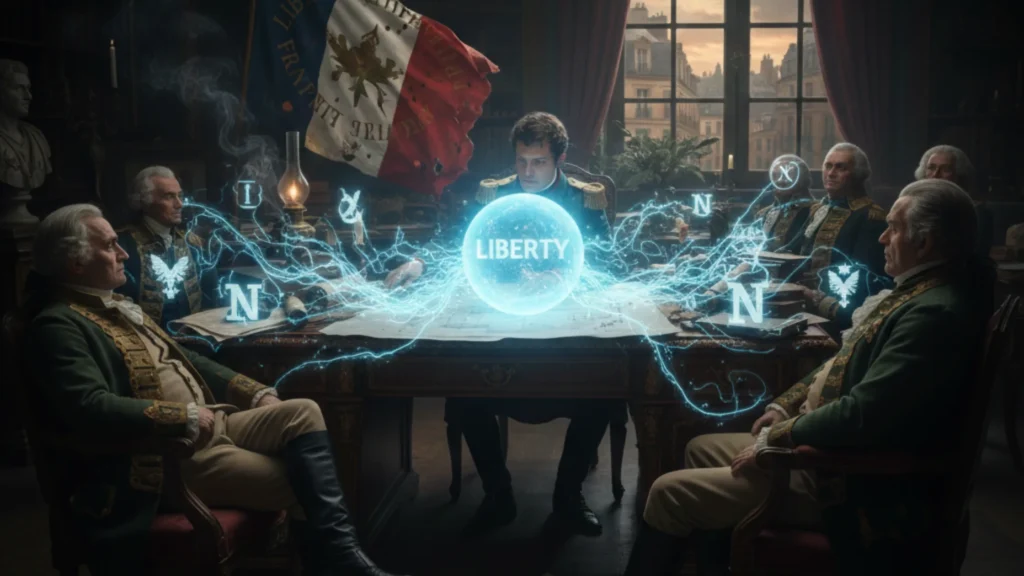
The genius—and the tragedy—of the Brumaire coup wasn’t the bayonets in the hall; it was the realization that the politicians were more afraid of the people than they were of the General.
Napoleon leveraged this fear with surgical precision. He presented himself not as a destroyer of the Revolution, but as its “liquidator.”
He claimed he was saving the best parts of the Republic by wrapping them in the protective, if suffocating, cloak of authoritarianism.
There is a striking bridge between this 18th-century maneuver and how we interact with our own systems of control.
We often surrender our agency to “platforms” that promise us convenience and security. We tell ourselves we are still “free,” even as the architecture dictates our choices.
Napoleon was the first great human algorithm. He streamlined French life—the Civil Code, the education system, the bureaucracy—in exchange for total control.
Think of a shopkeeper in Lyon in 1802. For ten years, his life has been a rollercoaster of hyperinflation and political purges.
Suddenly, the currency is stable. The streets are safe. There is a sense of national pride that feels like a drug.
Does he care that he can no longer criticize the government in the local rag? Probably not.
He is experiencing the “Napoleonic bargain,” a transaction that societies continue to make whenever the cost of complexity becomes too high to bear.
+ Why the Fall of the Roman Republic Was More Inevitable Than We Think
The branding of a legend: Was it all smoke and mirrors?
There are good reasons to question the traditional narrative that Napoleon was merely a military genius. In my analysis, his greatest victory was in the field of symbols.
He understood that a leader is not a person, but a brand. He replaced the crucifix with the bee, the Bourbon lily with the eagle.
He wore the simple uniform of a colonel of the Chasseurs à Cheval to stand out against the gaudy silks of his generals.
It was the ultimate “relatable leader” tactic—a calculated humility designed to make his eventual crowning feel like the people’s choice.
The trajectory of Napoleon’s rise to power was accelerated by his obsession with the “glory” of the past.
He dressed his regime in the robes of the Roman Empire because he knew the French people were desperate for a lineage.
They had cut their ties to the Bourbons and felt unmoored. By reaching back to Caesar and Augustus, he gave them a history that bypassed the messy, blood-soaked streets of the 1790s. He didn’t just give them a future; he gave them a dignified past.
What Changed After the “Napoleonic Bargain”?
| Feature | Pre-Napoleonic Chaos (1793-1799) | The Napoleonic Order (1804-1814) |
| Law | Over 300 different legal codes across France. | The Code Napoléon: A single, unified law. |
| Identity | Radical, fractured, and factional. | Nationalistic, centered on the state. |
| Career Path | Based on birth or political survival. | Meritocracy (mostly) for the talented. |
| Governance | Unpredictable committees. | A streamlined, centralized bureaucracy. |
Can we see the “Little Corporal” in our modern leaders?
When we look at the rise of “strongman” politics today, the pattern repeats with an eerie, almost mechanical precision.
Napoleon didn’t invent the dictator; he invented the popular dictator. He used plebiscites—referendums where the outcome was essentially guaranteed—to give his power a democratic veneer.
He knew that people don’t necessarily want to rule; they want to feel that they chose who rules them.
Consider the way a modern political campaign uses social media to create an echo chamber of inevitability.
Napoleon did this with woodblock prints and street theater. He ensured his face was everywhere, not as a tyrant, but as a tireless worker for the nation.
There are accounts of him staying up all night reviewing files, purposely leaving the candles burning in his office so passersby would see the light and think, “The Emperor is working for me.”
This “performative labor” is a cornerstone of modern executive branding. It’s the 1800s version of a late-night tweet from the office.
What is rarely discussed is the cost of this efficiency. While the Napoleonic Code brought a much-needed rationality to European law, it also codified the subordination of women and the re-establishment of slavery in the colonies.
The “strategy” was always about the consolidation of power; the “modernization” was often just the grease that made the machine run smoother.
The fragility of a power built on momentum
The most honest reading of Napoleon’s rise to power suggests that it was built on a treadmill that could never stop.
Because his legitimacy wasn’t rooted in tradition or in a stable, multi-generational constitution, it had to be fed with constant success.
He had to keep winning, keep expanding, and keep dazzling. The moment the momentum faltered, the psychological spell broke.
Imagine a veteran of the Grande Armée. For years, he has followed the Emperor across Europe, fueled by the belief that he is part of a superhuman movement.
But in 1812, standing in the freezing outskirts of Moscow, he realizes the Emperor is just a man who made a catastrophic mistake.
The “Strategy” of Napoleon was ultimately a gamble on his own infallibility—a gamble that every charismatic leader eventually loses.
The silent shift that occurred after his fall was the birth of the modern state. He proved that a centralized, bureaucratic machine could mobilize an entire nation’s resources with terrifying efficiency.
Every modern government, whether democratic or otherwise, operates on the hardware Napoleon installed.
We live in a world he built, even if we’ve spent two centuries trying to distance ourselves from his methods.
FAQ: Understanding the Napoleonic Strategy
Was Napoleon really that short, or was it propaganda?
It was largely a mix of “English propaganda” and a misunderstanding of French measurements. He was actually about 5’6″, which was average for the time. However, the “Little Corporal” nickname stayed because it suited the narrative of an underdog taking on the giants of Europe—a brand he was happy to lean into.
How did he manage to seize power so easily during the Coup of 18 Brumaire?
It actually wasn’t “easy.” He nearly fainted and botched his speech to the council. It was his brother, Lucien, who saved the day by pointing a sword at Napoleon’s heart and swearing to kill him if he ever betrayed the Republic. The army bought the theater, and the coup succeeded more through luck and Lucien’s quick thinking than Napoleon’s oratory.
Why is the Napoleonic Code still important?
Because it replaced a mess of feudal laws with a clear, logical system based on the idea that citizens were equal before the law. It influenced the legal systems of over 40 countries. It was the “software update” that the modern world needed, even if the developer was an autocrat.
Did Napoleon actually believe in the Revolution?
He believed in the efficiency of the Revolution. He liked meritocracy because it allowed a commoner like him to become an Emperor. He was less fond of the “liberty” part when it applied to people disagreeing with him.
Was his rise to power inevitable?
Nothing in history is inevitable. If the French Directory had been slightly more competent or the harvest of 1795 slightly better, the public might not have been desperate enough to hand the keys to a general. He was, above all else, a master of timing.
The story of the Corsican outsider who conquered a continent is more than a military epic; it is a cautionary tale about what happens when a society values order more than nuance.
If you’re curious about how this legacy shaped the borders of modern Europe or how his secret police set the standard for modern intelligence agencies, I can walk you through those shadows as well.
Would you like me to dive into the specific way he restructured the European map?
