
The Overlooked African Kingdoms That Dominated Global Trade
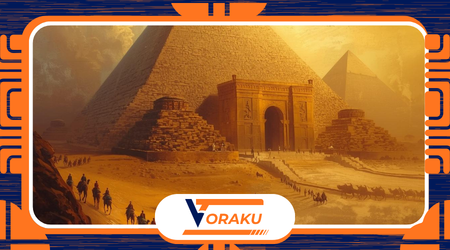
A caravan arrives before the sun fully commits to the sky.
The air is still cold, the sand holding onto the night.
Men move quietly, checking loads, tightening ropes, exchanging fragments of information that matter far more than the gold strapped to the camels’ backs.
Prices have shifted in Cairo. A shipment was delayed near Tripoli. Someone in Marrakesh is buying more salt than usual.
This is not improvisation. It is coordination. And it is happening in a world that rarely appears in the way global history is told.
Overlooked African Kingdoms were not operating on the margins of trade—they were setting its rhythm.
Continue reading the text and learn more!
Summary
- A marketplace in motion: the opening scene
- Why these kingdoms slipped out of mainstream narratives
- The hidden architecture of African trade networks
- Case study: the mechanics behind Mali’s wealth
- What is often misunderstood about African economic systems
- Repeating patterns in historical perception
- What shifted after their decline
- FAQ
Why do these kingdoms feel absent from the story we were told?
There is something unsettling about how entire systems can disappear—not physically, but narratively.
The omission of African kingdoms from global economic history is not simply an oversight.
It reflects a long-standing habit of telling history along the routes of later dominance.
Once Atlantic powers took center stage, earlier networks were quietly pushed into the background, as if relevance only exists in hindsight.
What complicates matters is the nature of the evidence.
These societies did not rely primarily on written archives in the formats European historians later privileged.
Their records lived in movement—in trade routes, in architecture, in oral traditions that required presence rather than paper.
That difference has consequences.
It creates the illusion that complexity was absent where, in reality, it simply took a different form. And once that illusion settles in, it becomes surprisingly durable.
++ Why Ancient Wars Were Often Won Before Battles Began
What did these trade networks actually look like up close?
The mental image many people carry—isolated caravans drifting across an empty desert—is misleading. It misses the structure.
Trade across the Sahara functioned less like a gamble and more like a system with rules, expectations, and enforcement.
Goods moved along routes that were politically managed.
Taxes were not arbitrary; they were calibrated. Protection was negotiated and maintained.
The Overlooked African Kingdoms—Ghana, Mali, Songhai—did not just benefit from trade. They engineered the conditions that made it possible.
Gold flowed north. Salt moved south. But behind that movement was something less visible and far more significant: control.
There is a detail that tends to go unnoticed.
++ The Political Myth of the “Dark Ages” Explained by Historians
These kingdoms did not always flood the market with resources. At times, they restricted access, deliberately shaping supply.
That decision, subtle as it may seem, reveals a level of economic awareness that challenges the common narrative.
Scarcity, in other words, was not always natural. Sometimes, it was designed.
++ Why Some Empires Left No Written Records
What made these systems hold together across such vast distances?
Distance alone should have broken them.
The Sahara is not a forgiving environment. It punishes miscalculation. Yet trade did not merely survive—it stabilized.
The explanation is not romantic. It is institutional.
Trust, across thousands of miles, does not emerge spontaneously.
It is built, reinforced, and occasionally enforced. Merchants relied on reputations that traveled ahead of them.
Agreements, even when not written in the European sense, were binding within shared cultural frameworks.
There is a tendency to underestimate systems that do not resemble modern bureaucracy.
But when observed carefully, the parallels become difficult to ignore.
Contracts existed. Standards existed. Consequences existed.
The Overlooked African Kingdoms operated with an understanding that still defines successful economies: predictability is more valuable than abundance.
Case study: what sustained Mali’s extraordinary wealth?
It is tempting to reduce the Mali Empire to a single image—Mansa Musa distributing gold during his pilgrimage, dazzling observers and destabilizing local economies along the way.
The story is told often because it is dramatic. But it is also misleading in its simplicity.
Imagine arriving in Timbuktu during Mali’s height. The city is not chaotic or improvised. It is organized. Goods are inspected.
Transactions are negotiated with care.
Scholars debate in nearby institutions, their work intertwined with the intellectual currents of the broader Islamic world.
This is not excess. It is infrastructure.
Wealth on that scale does not emerge from luck or mere possession of resources. It requires coordination at every level—administrative, logistical, political.
Caravans need protection long before they reach the city.
Routes must remain viable. Disputes must be resolved in ways that preserve trust rather than destroy it.
There is something revealing here: the spectacle of wealth often hides the machinery that produces it.
The Overlooked African Kingdoms were not defined by what they had, but by how they managed what they had.
What is usually misunderstood about African economic systems?
The persistent assumption is that these societies were rich in resources but poor in structure.
That assumption does not hold up under scrutiny.
Economic systems do not function at scale without shared expectations.
Trade across regions—especially regions as diverse as West Africa and North Africa—requires a degree of standardization that cannot be improvised daily.
Weights and measures, even if not identical to European systems, existed in consistent forms.
Dispute resolution mechanisms were embedded in social norms.
Reliability became a form of currency.
There is also a quieter dimension that often escapes attention: knowledge moved alongside goods.
Timbuktu was not an isolated intellectual anomaly.
It was part of a network where scholarship and commerce overlapped. Ideas, like commodities, traveled.
This complicates a narrative that places intellectual and economic development on separate tracks. Here, they were intertwined.
When the narrative shifts, what patterns begin to appear?
Looking closely, a pattern repeats with uncomfortable consistency.
Systems that do not align with dominant frameworks tend to be simplified, then sidelined. Over time, the simplification becomes the story.
The Overlooked African Kingdoms are a case study in that process.
What gets lost is not just detail, but agency.
These were not passive regions reacting to external forces.
They were shaping flows of goods, influencing prices, and negotiating power across continents.
There is a subtle but important consequence to forgetting that.
When history minimizes complexity in one region, it often justifies underestimating that region in the present. Perception hardens into assumption.
Assumption quietly influences decisions—economic, political, institutional.
And those decisions have long echoes.
What changed when these systems began to decline?
The shift did not arrive with a single event. It unfolded gradually, almost quietly.
Trade routes began to pivot toward the Atlantic.
Maritime networks, backed by emerging European powers, started to redraw the map of global commerce.
What changed was not just direction, but control.
| Before the Shift | After the Shift |
|---|---|
| Trans-Saharan trade dominance | Atlantic trade routes take precedence |
| Regional control over commerce | External powers dictate flow |
| Integrated inland networks | Fragmentation and dependency |
| Centers like Timbuktu thrive | Gradual decline of intellectual hubs |
This transition did more than redirect goods. It altered the balance of agency.
Where once African kingdoms had regulated trade on their own terms, they increasingly found themselves inserted into systems designed elsewhere.
The Overlooked African Kingdoms did not vanish overnight.
They were, in a sense, edged out—replaced not because they lacked sophistication, but because the structure of global trade itself had changed.
How does this past continue to shape perception?
There is a lingering tendency to treat parts of Africa as economically peripheral, as if integration into global systems is a recent development.
That view does not withstand historical scrutiny.
What becomes clear, when these earlier networks are taken seriously, is that the issue was never absence. It was interruption.
Economic systems that took centuries to build were disrupted, then redefined under new conditions.
The legacy of that disruption still influences how markets are perceived and evaluated.
There is something quietly persistent about inherited narratives.
They do not announce themselves. They operate in the background, shaping expectations.
And unless they are examined, they tend to repeat.
A closing reflection
The story of the Overlooked African Kingdoms resists easy framing.
It is not just a matter of restoring missing chapters. It requires reconsidering how the story itself has been structured—what was emphasized, what was ignored, and why.
Trade, at its core, is about connection. But connection is never neutral. It reflects power, perception, and the ability to define the terms of exchange.
These kingdoms understood that. They built systems around it.
And for a long time, those systems worked—quietly, efficiently, and with a level of sophistication that still feels underacknowledged.
What lingers is not just their legacy, but the gap between what was and what is remembered.
FAQ
Why don’t these kingdoms appear more often in mainstream history?
Because much of their history was preserved through oral traditions and material practices rather than written archives prioritized by Western historiography.
Were these trade networks truly global in impact?
Yes. Gold from West Africa influenced economies across Europe and the Islamic world, making these regions integral to broader economic systems.
Did these kingdoms have formal economic institutions?
They had structured systems—taxation, regulation, and dispute resolution—that functioned effectively across long distances.
What caused their decline?
A gradual shift toward Atlantic trade routes, combined with external pressures, reduced their control over commerce.
Why revisit this history now?
Because it challenges long-held assumptions and reveals a more complex foundation for global economic development.
++ Lesser-Known Empires and Civilizations That Shaped World History
++ Africa in the 1400s: Empires, Trade, and Power – Never a ‘Dark Continent
